
The Hill’s article exemplifies legacy media’s reflexive climate alarmism

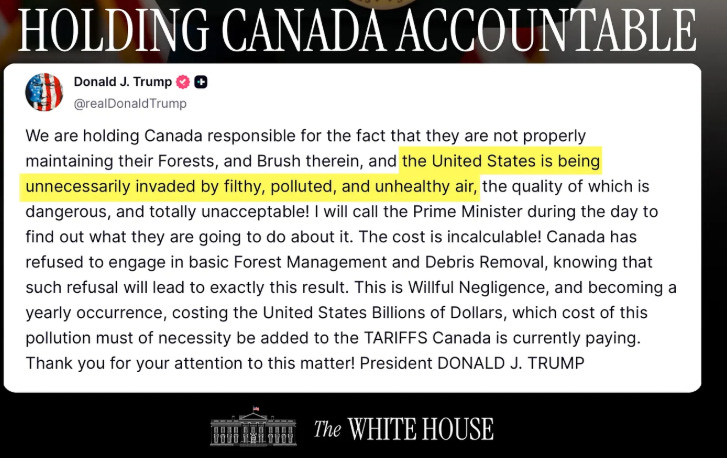
An article published today at The Hill typifies the legacy media’s habit of knee-jerking to adopt the preferred narratives of the climate alarm religion.
Headlined “Trump blames Canada for wildfires, but scientists disagree,” the piece portrays President Trump’s criticism of Canada’s forest management and his suggestion of adding pollution costs to tariffs as politically motivated scapegoating. As is typical of the legacy media, the story then elevates a handful of academics who attribute the smoke drifting into the U.S. primarily to climate change making fuels drier and fires more severe. This framing is predictable, selective, and incomplete.
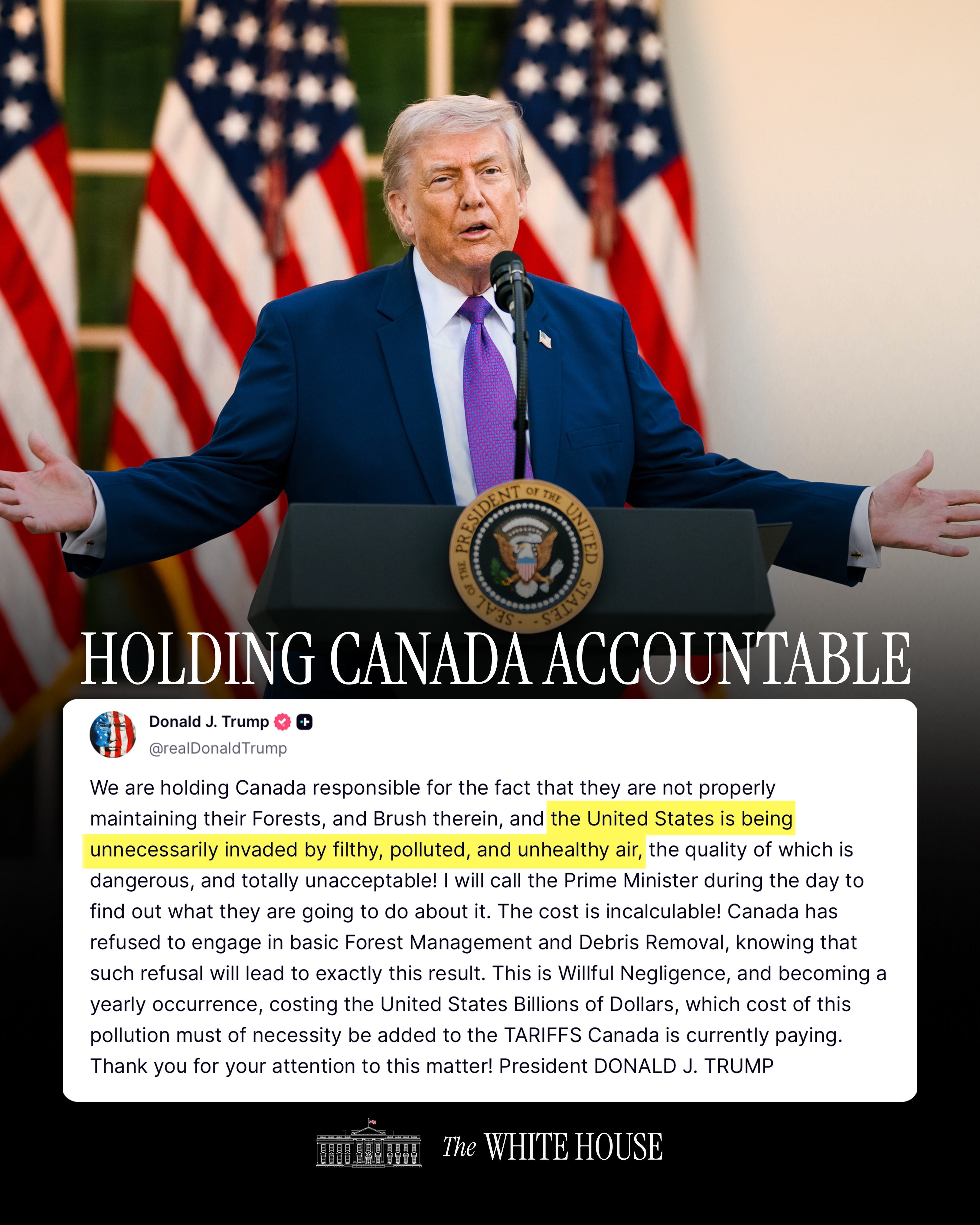
Trump’s core observation is straightforward: Vast Canadian forests are poorly maintained in many areas, leading to massive fuel loads. When fires ignite, whether by lightning, human carelessness, or arson, the results are larger, more intense blazes that send hazardous smoke southward. He has called this “willful negligence” and floated tariffs or damages to offset U.S. costs in the billions. Ontario Premier Doug Ford pushed back with aggressive rhetoric of his own, but the smoke events are real and recurring.
The U.S. has its own severe wildfire problems (California’s recent history is well-documented), yet the article uses this to deflect rather than address cross-border realities in trade and environmental policy. The article’s scientific citations focus on warmer, drier conditions amplifying fire behavior. Quotes from experts like Chris Field (Stanford) and Mike Flannigan emphasize that remote boreal forests are hard to manage intensively and that climate-driven dryness makes fires burn faster.
Mark Ashton notes historical fire cycles but claims today’s are “much more severe” due to amplified dryness. These points contain partial truth since temperature and moisture do affect fire weather, but they function as a rhetorical shield. The piece largely ignores ignition sources and long-term trends, treating “climate change” as an all-purpose explanation.
The data on ignition sources tell a different story: In Canada, lightning causes roughly 50-60% of wildfires nationally, often accounting for the majority of area burned in big seasons because strikes hit remote, dry fuels. Lightning has ignited fires for billions of years; it is not a new phenomenon invented by rising CO₂.
Human activity accounts for the rest: Campfires, equipment sparks, vehicles, debris burning, and yes, arson. Arson is a criminal subset of human ignitions, but overall preventable human starts are significant, especially early in the season.
British Columbia data shows lightning at ~60% and human causes at ~40%. Similar splits appear in national figures. Attributing these to “climate change” lets bad actors and policy failures off the hook while excusing the need for better prevention and enforcement.
Trends also contradict the alarm narrative: Global satellite data (MODIS-based products like GFED5 and GWIS) show annual burned area declining over recent decades - roughly 1-1.4% per year in some analyses since the early 2000s, with a cumulative drop of 20%+ in many records.
The decline is driven heavily by savannas, grasslands, and agricultural expansion/fragmentation in places like Africa. Forest burned area has been more stable or shown modest regional shifts. In western North America, area burned has increased since the 1980s in some metrics, but peer-reviewed studies indicate current levels remain below pre-20th-century norms in many forest types when accounting for centuries of data.
A persistent “fire deficit” exists across much of North America due to aggressive 20th-century suppression policies that allowed fuel to accumulate. Nature is partially reverting toward historical regimes, compounded by decades of stupid policies driven by alarmism which mandate reduced mechanical thinning and prescribed burning.
Meteorologist Chris Martz has highlighted these patterns with data: global burn area at multi-decadal lows in recent years-to-date in some periods, no statistically significant global drought expansion since reliable satellite records began, and U.S. heatwave frequency actually lower in long-term comparisons when properly defined.


Western increases since the 1980s align more with fuel buildup from fire exclusion than with a simple CO₂-driven catastrophe. Pre-industrial California saw average annual burns estimated in the millions of acres, sometimes exceeding even notorious modern seasons when viewed over centuries.
The Hill piece and its quoted scientists emphasize severity under extreme weather while downplaying that effective management (thinning, fuel breaks, targeted prescribed burns) demonstrably reduces intensity and spread even under hot/dry conditions. Claims that remote areas make management “impractical” overlook scalable options used successfully elsewhere and the reality that a small percentage of fires cause the vast majority of burned area. Full “bulldozing” is a straw man; targeted intervention works.
For the legacy media, this is the standard template: Legacy outlets quote credentialed voices who frame every bad fire season as proof of the climate religion, while sidelining counter-data on ignition, historical context, and management failures.
It serves a narrative that justifies expansive emissions policies and deflects accountability for land-use decisions. Canada’s boreal forests are naturally fire-prone; pretending they can be rendered fireproof through global CO₂ cuts is magical, un-scientific thinking.
Trump’s tariff comments come amid broader trade tensions, including the ongoing renegotiation of the US/Mexico/Canada Trade Agreement. Smoke incurs real U.S. costs in health, tourism, and productivity. Using trade leverage to encourage better neighborly practices is a legitimate policy tool, not mere bullying.
The article’s contrast pitting “reasonable” Canadian officials and scientists versus reckless Republicans reveals the bias. Empirical reality is messier than the article allows. Wildfires are ancient; Lightning and humans have always started them; Global burned area has not exploded - it has trended down overall.
Regional upticks in the West reflect fuel accumulation and weather variability more than an unprecedented climate-driven apocalypse. Better data-driven management, aggressive pursuit of arsonists and negligent actors, and realistic forest policy outperform ritualistic genuflection to the CO2-driven climate gods.
The Hill’s piece does readers a disservice by reducing complex ecology and policy to a climate morality play. Truth-seeking requires weighing all factors without subordinating evidence to a preferred and highly political narrative. Recent Canadian smoke events highlight the need for practical cooperation and accountability, not more sermons about too much plant food in the atmosphere.
That is all.
I would expect nothing less from The Hill. It moves further to the left week by week.
Of course there is no mention of the premier of Ontario, Doug Ford, who is by far the biggest moron in Canada and runs the province of Ontario. Meanwhile it has one of the largest continuous masses of forest in the world covering 174 million acres. So, what is he doing to help curb ongoing wildfires? He cuts $42 million for the wilderness firefighting budget and was gung ho in 2021 when Trudeau promises to budget $450M for new water bombers and 1,000 fire fires and millions in more to provinces for production of additional water bombers.
So, that was 5 years ago, so how did it go? Oh, it's instead, the "Let er burn policy"! So, Ford is now in front of the cameras telling America to step up and head to Ontario now!
Sure, and in October, 2025, Ford threatened to cut off electricity to the East Coast, and ran a 1988 edited version of an audio of Regan denouncing protectionism and criticizing Trump. And he does this during the World Series and while SCOTUS is in oral arguments on Trump's authority on tariffs. This guy has booed at our National Anthem, and tells Canadians not to travel to the U.S. and once again got on television to pour American whiskey down the drain as Canada bans American liquors.
So, sure, let's just jump to the rescue and go get our water bombers and assist this jerk? I think NOT!