
WATCH/READ: Excellent Chris Wright Interview with Maria Bartiromo

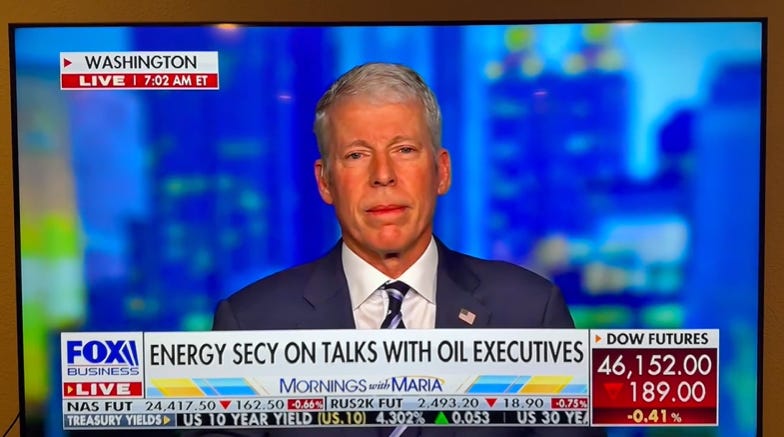
As a service to readers, I stood still in front of my TV for 12 solid minutes recording this lengthy interview with Secretary Chris Wright this morning. It’s wide-ranging and chock full of valuable information.
Give it a watch - a transcript follows:
Transcript:
Maria Bartiromo: [00:00:00] Joining me right now to talk more about all of that is U.S. Energy Secretary Christopher Wright. Mr. Secretary, it’s good to see you this morning. Thanks so much for being here. [00:00:06][6.5]
Secretary Wright: [00:00:08] Thanks for having me, Maria. [00:00:09][1.0]
Maria Bartiromo: [00:00:10] I want to go back to what the Treasury secretary told me yesterday, Scott Bessett, telling us that the U.S. In the coming days may unsanction that oil sitting on the water. If that Iranian oil is unsanctions, how many barrels would hit the market and what would be the timeline on that? Can you give us a sense of how long that would take in terms of the oil hitting the market, how fast it would take? [00:00:34][24.2]
Secretary Wright: [00:00:37] Yeah, so I think that most of that oil will be absorbed in the next 30 to 45 days. See, what we have is an interruption of flows outside of the Persian Gulf, but yet, as Secretary Besant said yesterday, we’ve got over 100 million barrels in crude tankers that’s on its way or floating, waiting to unload in China. That oil is already going to be sold. It’s going to show up in China, but China has not been releasing strategic petroleum reserves, and they banned the exports of diesel and gasoline and jet fuel that they supply to their Asian neighbors. So this is a way to let those barrels flow into India or Vietnam or Indonesia, somewhere else where those barrels will get refined and supply the products needed in Asia. [00:01:21][44.8]
Maria Bartiromo: [00:01:22] So would you expect an impact on prices? [00:01:24][2.6]
Secretary Wright: [00:01:28] Well, you know, I think the market has seen that the United States is going to be very pragmatic here. We have an interruption of oil flows, and we want to fill it every way we can, from SPRs, from floating barrels that are just lined up to go into China, to any other actions we can take, of course, for growing U.S. Production and Western Hemisphere production in general. So look, I think that prices are probably discounting that although there’s interruptions of flows from the Straits of Hormuz, the world has a lot of oil today. [00:01:59][30.7]
Maria Bartiromo: [00:01:59] So what’s the timeline from the unsanctioned to the usable supply? [00:02:02][3.2]
Secretary Wright: [00:02:06] Well, with unsanctioning, within days, within three or four days, that oil will start to arrive at ports, and of course most refineries are near ports, so pretty quickly. [00:02:16][9.8]
Maria Bartiromo: [00:02:17] And Secretary, I know you met with the oil executives at the White House yesterday. Can you tell us what struck you most and what came out of that meeting that could be critical in this moment in time? [00:02:26][8.8]
Secretary Wright: [00:02:28] Yeah, well, look, what’s great about those executives is over the last, you know, 10 years from the first Trump term and through the Biden years, despite the withering attacks, they’ve grown American production. American production of oil, American production of natural gas, American production of liquid petroleum gas kind of in between the two. It’s also a critical global commodity. They built infrastructure, got hard to build infrastructure during the Biden administration. So they’re very passionate to be able to build the pipelines needed so states like New England and California can also get the low price to energy that the rest of our country has so they’re ready to invest They’re ready the lean in they just need to get in the government to get out of it get out Of their way. It was it operated overseas of course have concerns that are if you’re in the Middle East [00:03:16][48.0]
Maria Bartiromo: [00:03:17] your concern about your assets? Sure, because the security of the Strait of Hormuz has been front and center here, but you make a great point, the executives and the industry in general want the government out of the way, and they were handcuffed during the Biden administration. President Trump has prioritized deregulation. He even put some of that in the Big Beautiful bill. I know, but there are other things regarding permitting that people in the industry say needs to be codified. What do you want to see in terms Congress’s role here in terms of codifying some of those things with regard to permitting so that in fact the government can get out of the way. [00:03:52][35.4]
Secretary Wright: [00:03:55] Yeah, we’d love to get a permitting reform bill through Congress. You know, that’s not a reconciliation bill, it doesn’t fit in that box, so we’ve got to get meaningful Democratic votes for that. But I think there’s a possibility that can be done. Again, this is a unique thing about President Trump that I believe he can bring together a coalition from both parties to support permitting reforms so that you can get things done just quicker in this country. We can’t build big infrastructure in a reasonable time frame in the United States. We’re kind of stuck where we are today. That’s not the American way. We’re about building things quickly, driving progress, and bringing the American people new jobs at lower costs. But that means you have to be able to build. [00:04:39][44.7]
Maria Bartiromo: [00:04:40] And of course you’ve been trying all you could. The administration is trying to put all hands on deck in terms of moving the needle. On lowering oil prices in the middle of all of this, when does it become that you’ve got the realities of the market with oil at $100 or near $100 a barrel right now colliding with the maximum pressure campaign that the president has on Iran? Some people are saying, look, how do you justify Iran monetizing oil during this conflict? [00:05:07][27.4]
Secretary Wright: [00:05:10] You know, this is a very short-term period. That oil was going to be monetized anyway. Again, it was just waiting in a line to unload in China. So that head oil would have been monetized other ways. But the action against Iran right now is to just pummel their military capabilities. For 47 years, they’ve terrorized their neighbors. They’ve had multiple attempts to block the flow of oil through the Straits of Hormuz before. They have been a geopolitical influence that has driven up the price of energy through my entire adult life And we just did not want to kick that can down the road to one more administration. Because Iran spends almost all its oil and gas money on armaments, you know, conventional armaments surrounding a nuclear program. Like you cannot have a nuclear-armed Iran. They would be able to put pressure whenever they want, wherever they want. If they had nuclear weapons and a massive nuclear arsenal. So this president has had the bold leadership and our military every day every hour of every day is degrading Their ability to terrorize their neighbors threaten Americans and the infrastructure to build the next round of armaments This is a bad. It’s it’s a rough conflict to go through, but it is very very necessary [00:06:27][77.2]
Maria Bartiromo: [00:06:27] Absolutely and our viewers understand clearly that this is national security. Scott Besson said it really well yesterday when he said look I’m asking about economic growth. He said look economic security is national Security, so once we get a potential nuclear Terrorists out of the way and and defend then of course you’re talking about a resumption of economic growth Let me get your take on on the moves around the strategic petroleum reserve What is there a level out there that would move your hand in terms of releasing more oil from the SPR? And how would you assess or characterize the SPL levels today versus historical norms? [00:07:09][41.7]
Secretary Wright: [00:07:12] Yeah, look, unfortunately, the Biden administration took 200 to 300 million barrels out of our strategic petroleum reserves to try to help themselves in the midterm elections in 2022, certainly the most egregious misuse of what the SPR is for. But we have announced that, again, it’s not just the United States. With over 30 nations of the world, we announced coordinated releases to flow oil into the market, to displace some of the barrels not coming out of the Straits of Hormuz. That’ll occur over the next few months, and I think, as you know, we didn’t sell those barrels so they’re gone. We just traded them. We traded a barrel of oil delivery today or in the next months during this shortage for over 1.2 barrels of oil to be delivered to us, you know 12 to 18 months from now. So at the end of all this, we’ll actually have more barrels in the SPR than we had before with no new taxpayer money. So we’re just bringing oil forward when it’s needed and we’ve already made trades to refill that oil with more than a barrel for each barrel we take out. So but I think we’ve done a good thing there and we got the countries of Asia and Europe to come along with us. The oil is needed in Asia more than it’s need in the United States, but we’re playing our part in that coordinated release. [00:08:33][81.3]
Maria Bartiromo: [00:08:34] Well, we know that, Secretary, you are sitting at the center of the President’s energy strategy, of course, talking about everything from the Strait of Hormuz logjam to America’s energy dominance all at a time when we are seeing demand soar with this buildout of data centers and this AI boom that we’re watching. You’re headed to Ohio today with the CEO of SoftBank, Masayoshi San, and Commerce Secretary Lutnick for a big announcement tied to the investment between the U.S. And Japan. What can you tell us about that? When will we see the details coming out of this trip? [00:09:05][31.8]
Secretary Wright: [00:09:08] Yeah, this is an extremely exciting project, and look, this, this is at a location that used to be a gaseous diffusion plant. So think soon after World War II, this was a very necessary process for the United States to build our nuclear arsenal and ultimately to prevail in the Cold War. So a large industrial site that used to consume gigawatts of power for, again, a very large physical infrastructure. That was radioactive. We cleaned it up over the last 20 years and got it prepared. It’s a brownfield, but ready for new development. And what more perfect development than to build several many gigawatts of new electric generating capacity that will power data centers, that will power other next generation manufacturing and industry in this area. It will be an absolute boom for this region of Ohio. It will help keep the United States in the lead and artificial intelligence and it’ll grow the capacity of our power grid so we can not only meet this new demand but push down prices. That’s what we need to push down in our country, is instead of the closing of power plants that were celebrated in the Biden administration, we’re going to celebrate the construction of new power plants. And these power plants are powered by natural gas, which is the superpower of American energy. The price of pipeline-delivered natural gas in our country, our largest source of electricity, our largest sources of home heating, has been completely unimpacted by what’s going on in the Middle East. That’s part of the magic of American natural gas. [00:10:47][99.1]
Maria Bartiromo: [00:10:47] And I guess also the magic of all hands on deck when it comes to energy, whether it’s LNG, obviously oil and obviously gas, but also nuclear, which is something that you’ve talked about a lot. [00:10:59][11.9]
Secretary Wright: [00:11:02] We’ll build nuclear plants at this site as well. So this will be a massive energy campus. We will break ground eminently on the natural gas plants. But it’s also a perfect site for us to build a few nuclear power plants that will continue to grow the power in that region and help launch that American nuclear renaissance. So I couldn’t be more excited. My fellow secretary, Howard Lutnick, did a tremendous job in negotiating a trade deal with Japan that brought wins for Japan and wins for the United States. And those huge wins for United States include this money, these investments from Japan to make American infrastructure better. Japanese contractors and their companies will be involved in the products supplied as well. So it’s a great partnership. Unfortunately, my other key energy partner, Secretary Doug Burgum, at the last minute is not able to make the event today, but he’s been a huge enabler of building energy infrastructure in this country and getting the governors across the country to realize the way to make the lives better for their states is to stop the crazy climate alarmism of the past. Just bring common sense. If you bring more energy and more infrastructure to your state, you’ll lower the cost for your citizens and you’ll increase their job opportunities and help push their wages up. I think that’s a common sense agenda. And we can get everyone around. [00:12:26][84.5]
Maria Bartiromo: [00:12:27] So is the U.S. Currently producing at maximum capacity or are there certain policies still holding it back? [00:12:33][6.3]
Secretary Wright: [00:12:36] What holds us back in producing energy in the United States is pipelines and infrastructure. We produce all we can right now, given our pipeline infrastructure. But if you build more pipelines to move natural gas, we can produce far more natural gas than we produce today. And in fact, we need more pipelines out of West Texas and Southeast New Mexico to bring the natural gas to enable the increase of production of oil in that region. But that’s the kind of stuff you’re going to see under this administration, is to build that long-term infrastructure that allows America to grow our energy production even more which is great for America and great for our allies around the world. [00:13:16][40.0]
Maria Bartiromo: [00:13:16] Real quick before you go, what do you make of this comment from Saudi Arabia officials that oil prices could soar past $180 a barrel if the disruptions persist until late April? [00:13:28][12.1]
Secretary Wright: [00:13:31] Yeah, Iran’s attacks have been terrifying because, you know, these are countries, they’ve lived near for decades. They’re aiming at their airports, their apartment buildings, their condo buildings, their energy infrastructure. So this destruction certainly is not helpful for global oil prices. The United States military needs to finish the job to defang Iran’s ability so they won’t do this for the next 47 years. But we’ve got to get through the period we’re in. Thank God we have American energy dominance. [00:14:03][32.2]
Maria Bartiromo: [00:14:03] Good to see you this morning. We’ll be watching your work, sir. Thank you. [00:14:06][2.4]
Secretary Wright: [00:14:08] Thanks for your time. [00:14:09][0.6]
Maria Bartiromo: [00:14:08] All right, I understand. [00:14:08][0.0]
[808.2]
It’s still dizzying to think of the contrast from Granholm to Chris Wright. Incredible work that hopefully will be felt for the next 5-10 years.
.