

[Note: A bipartisan group of senators claim to have reached a tentative agreement on permitting reform legislation just as the Senate goes on vacation until after the November 3 election. That, of course, gives Democrats - who can never be trusted to bargain in good faith with Republicans - 6 weeks to come up with more demands that will most likely kill this deal, because that is what Democrats do. But in the meantime, this compromise is worth supporting, so I posted about it on X.]
Full Text:
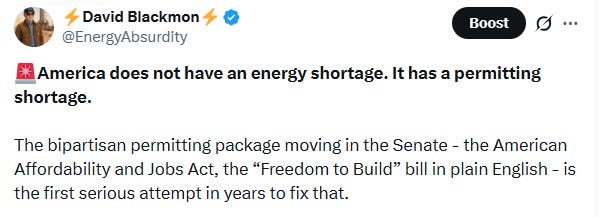
America does not have an energy shortage. It has a permitting shortage.
The bipartisan permitting package moving in the Senate - the American Affordability and Jobs Act, the “Freedom to Build” bill in plain English - is the first serious attempt in years to fix that.
Capito, Lee, Whitehouse, and Heinrich are not pretending the problem is a lack of studies. The problem is a system that treats delay as a virtue.
USOGA, API, IPAA, and the project developers who actually pour concrete are right. More than 650 major infrastructure projects are stuck in federal review, representing something on the order of $1.1 trillion to $1.5 trillion in investment.
McKinsey has estimated that construction costs rise 24 to 30 percent over long permitting timelines, mostly from materials, labor, and overhead while lawyers argue.
An ICF analysis commissioned by API finds comprehensive reform could cut residential electricity bills by a combined $55.6 billion from 2026 through 2035, support about 705,000 jobs, and generate nearly $24 billion in tax revenue by 2030.
That is the affordability case. It is math, not theory.
What the bill actually does:
Narrows NEPA so reviews cover impacts tied to the project, not every hypothetical downstream effect a litigant can invent.
Puts a 150-day clock on lawsuits and limits challenges to parties who commented and can show direct harm.
Stops courts from vacating a finished permit while an agency fixes a paperwork defect. Remand the document. Do not halt the job.
Keeps Clean Water Act Section 401 focused on water quality from a discharge, not a backdoor climate veto.
Makes statutory deadlines enforceable, including a path to court when agencies simply refuse to decide.
Environmental and safety standards stay. Endless process does not.
Senator Mike Lee put it cleanly: The bill makes it easier in America to build things.
Both parties claim they want lower power bills, more manufacturing, and data centers that do not stick households with the tab. None of that happens if every linear project spends a decade in review and another five years in court.
The Senate will need 60 votes after the midterms. Pass the bill. Finish the job this year. American energy should not have to wait in line for Washington’s bureaucracy.
As Tim Stewart, President of USOGA, said it all in a post Wednesday: “Pass the frickin’ bill so we can start building things again.”
The man is always right.
Pass the frickin’ bill, congress.
That is all.
And yes, that is all.
It is time to hold elected politicians (aka putz’s) to perform their jobs and finish the legislation. Constant delaying and deferring can no longer be tolerated. Extended time out of session can no longer be tolerated. We’ve elected them and pay them handsomely for what turns out to be a paltry effort. So while I’m at it, we shoujd cancel their retirement plan and reduce their benefits including healthcare. Hold elected office holders accountable!
As the owner of a consulting business that prepares NEPA documents and does all of the supporting investigations, I STRONGLY support this legislation. It has long been an inside joke among NEPA consultants that the “cumulative impacts” section of EAs and EISs is the most ridiculous section in those documents. It is usually pure made up fantasy. The guidance says to analyze the potential effects of the proposed project when considered in combination with all other past, present, and reasonably foreseeable projects that might result in a greater impact than if the project were considered alone. This idiotic analysis would, if done properly by that directive, would result in “significant impacts” nearly every single time, which would kick the NEPA analysis over to an EIS every time, which would obviously be crazy. Thankfully, cumulative impacts analysis was struck by the Trump Administration very early in Trump’s second term. More needs to be done. This bill sounds like it just might get the job done.
To be clear, NEPA and the bevy of other environmental laws on the books have kept America from destroying the environment the way other countries, like China and Russia have, as well as many smaller third world countries, but it was never meant to be used as a cudgel to stop development. Only to make sure that a project does not do something stupid that could have easily been avoided if someone had taken the time to look at it from an environmental protection perspective.
As David rightly says here, “pass the frickin’ bill!”